This episode of Allies at Work is addressing a heavy topic—gender-based violence. While today’s guests present their findings from a scholarly and third-person perspective, these stories can be distressing for some. If you’d like, you may skip to the middle of the episode to the positive actions that male allies can take to help prevent gender-based violence. And if you are experiencing abuse in your own life, please call the National Domestic Violence Hotline at 800 799 7233. Or text S-T-A-R-T to 88788. Help is available now.
1 in 3 women will be subjected to physical or sexual violence in their lifetime, according to research from the World Health Organization.
In this episode of Allies at Work, you’ll hear from Suzie Greco and Sharmin Prince on the topic of Gender-Based Violence.
The work of allyship requires us to confront painful truths and increase our awareness of all forms of inequity. While this isn’t an easy topic to address, it is critical to gender equality.
Meet Suzie Greco and Sharmin Prince
Suzie Greco is a master’s student at Harvard Divinity School with a focus on women, gender, sexuality, and religion. Suzie is also a board member of the Global Collaborative, a survivor-led network of child advocacy organizations committed to ending child sexual abuse.
Suzie shares the importance of men and women supporting each other as we confront sexual violence—and emphasizes the unique value of female-to-female allyship. Suzie also unpacks the role patriarchal and religious structures can inadvertently play in perpetuating gender-based violence.
Sharmin Prince has worked in non-profits and mental health for the last 20 years. Like Suzie, Sharmin is an expert in Gender-Based Violence. Through her nonprofit, Eagles Empowered to Soar, Sharmin does an incredible job of challenging privileged folks like me to think harder about how we can be more intersectional and more intentional in our allyship.
Sharmin shares how the socialization of boys can empower them to become male allies. Despite over 20 years of entrenchment in this emotionally challenging work, Sharmin offers a voice of hope.
A few favorite moments
“I believe that our problems with inequality and gender-based violence [are] because of how we’re raising our boys and girls.”
Sharmin Prince
“We as women will stand together unified to protect one another to thwart and ward off patriarchal and gender violence.”
Suzanne Greco
“If men can be that male role model and be that male support to boys, I think we can create a utopia.”
Sharmin Prince
To hear two experts discuss the role allies can play in eliminating gender-based violence, listen to the full episode below.
Allyship action: Avoid violent language
At the end of each episode, I share an allyship microaction—something you can start doing right away. Today’s allyship action: Avoid violent language.
The issues of gender based violence cannot be resolved in a day, but we can be conscious of the way our language and our beliefs may be impacting situations like this.
In historically male-dominated corporate spaces, aggressive jargon is commonplace:
I’m killing it.
You need to pull the trigger on this.
We dodged a bullet there.
We can remove violent language and opt for clarity and kindness instead. Here are a few examples from Anna Taylor, Director of Communications:
Instead of saying, “I’ll take a stab at it,” try saying, “I’ll take the first pass.”
Instead of saying, “You’re killing it,” try saying, “You’re doing extremely well.”
Instead of saying, “Let’s pull the trigger,” try saying, “Let’s go live.”
Being conscious of and removing violent language from our vernacular helps us to create safer spaces for survivors, who are often women.
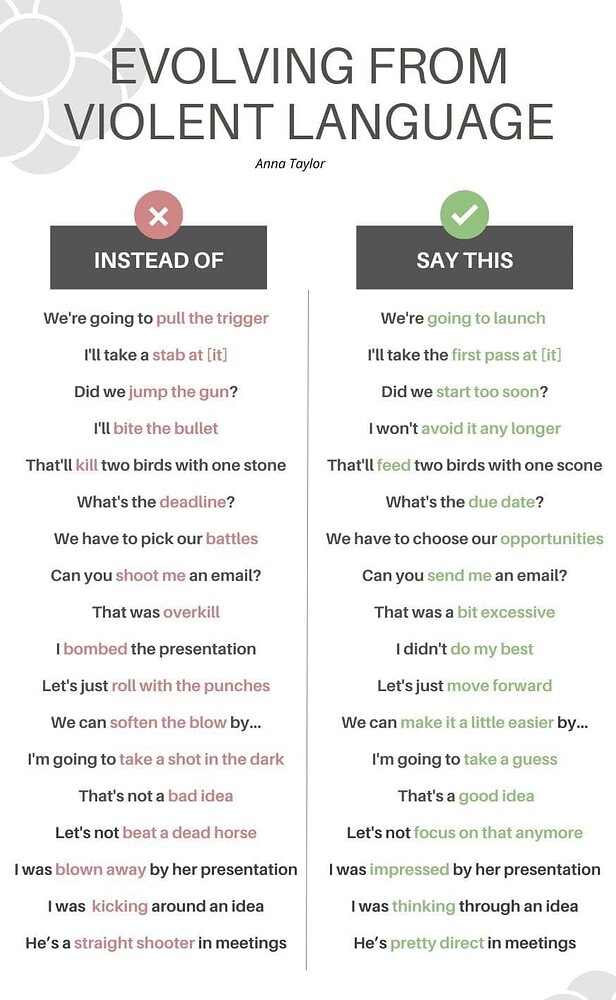
This might not seem like a big deal to you, but like Suzie shared, It’s hard to understand the negative effects of gender-based violence, unless you’ve experienced them personally.
David Foster Wallace famously said that “everything in our immediate experience supports the deep belief that we are the center of the universe.” So while it’s a good thing if you haven’t been impacted by gender-based violence, that doesn’t mean that there aren’t folks in your workplace who have, and who might be triggered by insensitive language.
Allies stress test their beliefs
Another thing we can do to get out of our own reality and understand what others are going through is to stress test our own beliefs. We’ll talk more about this in the next episode—when we hear a female pastor and an expert in ancient Roman spirituality about how allyship overlaps with religion.
But here are a few questions to chew on in the meantime. Megan Phelps Roper, writer and activist who famously left the Westboro Baptist church after campaigning with them for years, suggests that you ask yourself these three questions to get curious about your beliefs.
First, can you articulate the evidence that you would need to cede your position? Or is your perspective unfalsifiable?
Second, are you attacking ideas? Or are you attacking the people who hold them?
Third, are you willing to use extraordinary means—including violence or threats of violence—against people who disagree with you?
These are challenging questions, but as we reflect on them honestly, we will help to create more peaceful communities where gender parity is achieved.
Sign up below so you never miss an episode!
 Rachel Cottam